
A virtual assistant runs the admin of someone else's working day from a distance. Here is what the job actually involves, who hires for it, what it is not, and how Nigerians get into it.
What Is a Virtual Assistant? The Job Explained for Nigerians Who Want to Do It
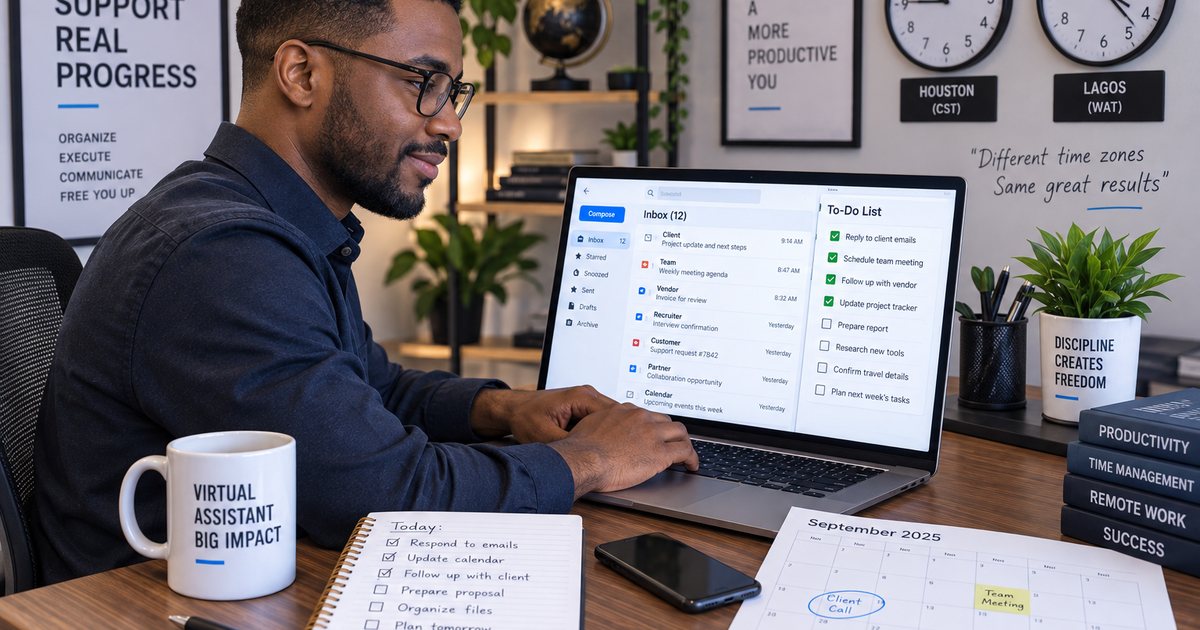
A virtual assistant is a remote administrative professional who manages an inbox, a calendar, tasks, documents and follow-ups for a business owner, an executive or a small team, usually in another country. The job is trust, judgement and consistency more than any single tool. Nigerians get in through agencies, freelance platforms and direct referrals, almost always after showing they can be trusted with someone's inbox. Pay varies with the client, the hours and the market; check current postings rather than any figure a course prints.
SchoolRegistry Editorial Team · Last updated: September 2026
This explainer is written for someone who has heard the term and wants to know what the work is before deciding whether to train for it. The examples come from the Academy's Virtual Assistant track and from the tasks that appear in current job postings.
What a virtual assistant does all day
Strip away the title and the job is this: a person somewhere else has more work than hours, and you take the part of it that can be done from a distance. In practice that means the inbox (reading, sorting, drafting replies, flagging what needs the owner), the calendar (booking, moving, confirming, protecting time), the task board (keeping the list true), documents (formatting, filing, chasing signatures), research (finding a supplier, comparing prices, summarising) and follow-ups (the invoice that has not been paid, the meeting that needs rescheduling).
The word virtual only means remote. The word assistant undersells it. A good assistant is the reason an executive's week works, and a bad one is the reason it does not.
The tools are ordinary: Gmail or Outlook, Google Calendar, a task board such as Trello or Asana, Slack, Zoom, Google Docs. Nobody hires for tool skills alone. They hire for whether you can be handed an inbox on Monday and still be trusted with it on Friday.
Who hires virtual assistants, and from where
Three kinds of employer. Small business owners and solo professionals in the US, UK, Canada and Australia, who hire directly or through platforms. Agencies that place assistants with those clients and take a margin. And larger companies that hire remote administrative staff on contracts.
Nigerians appear in all three. The route is usually a platform or an agency first, then referrals once you have a track record. The six-step path in our VA jobs guide walks through it, including how to tell a real posting from a fee scam.
What the job is not
- It is not data entry. Data entry is a fifth of the job on a bad week.
- It is not customer service, although the skills overlap; the assistant serves one principal, not a queue of customers.
- It is not a get-rich scheme. Anyone selling a VA course with an income figure on the cover is selling the figure, not the skill.
- It is not entry-level typing. The hardest part is judgement: what to escalate, what to decide, what to leave alone, and how to say no to the owner's inbox on the owner's behalf.
How Nigerians get started
Learn the work on a real inbox, even a practice one, before you apply. Build evidence: a portfolio of the kind of work the job involves, not a certificate on its own. Then apply where the work is, with a CV that names tools and outcomes rather than adjectives. The Academy's Virtual Assistant track is one route: ten weeks, a simulated executive's inbox, tutor-marked assignments and a practicum at a fictional workplace, ending in a certificate an employer can verify. It is not the only route, and it does not promise a job. It does give you graded work to show.
If you are not sure virtual assistance is your fit at all, the free Find Your Path tool compares it with the other Academy tracks in two minutes, without an email address.
Sources & Further Reading
- US Bureau of Labor Statistics, Secretaries and Administrative Assistants — the official description of the administrative work virtual assistants do remotely
- SchoolRegistry Academy, Virtual Assistant track — the curriculum and sample lesson referenced above
- How to become a virtual assistant in Nigeria — the step-by-step guide, including the scam filter
Frequently Asked Questions
Do I need a degree to be a virtual assistant?
No. Employers hire on demonstrated reliability, written English and tool fluency. A degree neither helps nor hurts much; evidence of work does.
How much do virtual assistants in Nigeria earn?
It varies with the client, the hours, whether you are paid in naira or in dollars, and the market that month. We do not print a figure because it would be wrong by the time you read it; check current postings on Jobberman, Upwork and LinkedIn.
Is a virtual assistant the same as a personal assistant?
Close. A personal assistant is usually on site and often handles personal errands. A virtual assistant is remote and mostly handles the working day, though the line is blurry with some clients.
Can I do this part time?
Many do, especially at the start. Most clients care about response windows and reliability rather than fixed hours, but you must be honest about your availability.