
Hours first, rate second.
The dispatcher's line: carrier's agent, never a broker
Learn · Practice · ApplyA ten-week certificate course in remote truck dispatching: reading a load board, working out the all-in cost per mile that decides every yes, calling a broker on a load, checking the rate confirmation field by field, planning a week inside the driver's legal hours, assembling the payment packet, and reporting the week to the owner without softening the bad news. Taught on DAT One, Truckstop and a dispatch board, with one fictional carrier, Redline Carriers, whose drivers, brokers and lanes stay consistent all course.
Not sure this course is right for you? Find your training path ↗
Or try a sample exercise—no sign-upTraining for remote work. A certificate does not guarantee employment.
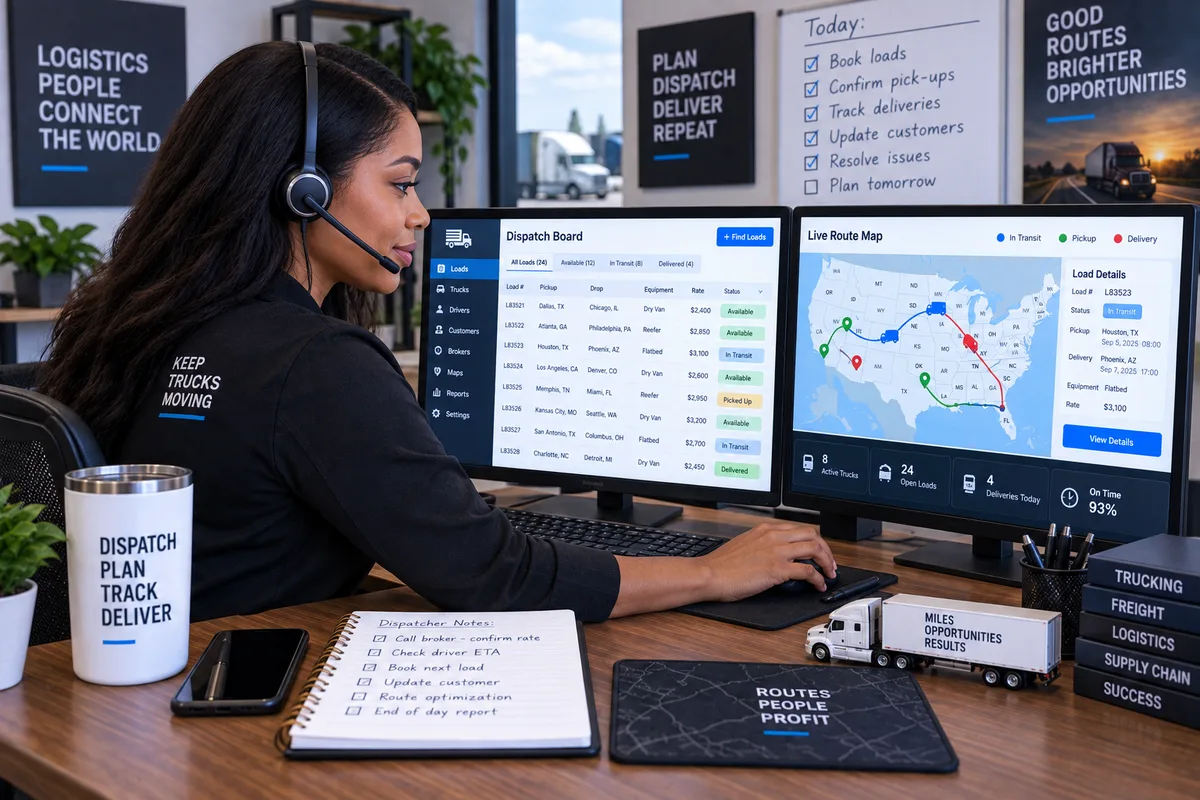
Ten-week certificate course in remote truck dispatching for US carriers: load boards, cost per mile, calling on loads, rate confirmations, hours of service, payment packets, factoring, breakdowns and the weekly owner report, taught on DAT One, Truckstop and a dispatch board with a two-week practicum.
The dispatcher's line: carrier's agent, never a broker
Learn · Practice · ApplyReading DAT One and Truckstop postings
Learn · Practice · ApplyAll-in cost per mile and the floor
Learn · Practice · ApplyMove from a load board to eight trucks planned for a week: legal hours, fair rates, clean paperwork. Select a moment below to look inside the practice.
Find a load home that clears the floor, then call on it.
Deadhead is the miles nobody pays for.
Ask the pickup window, dock hours, commodity and payment terms, then confirm every number back.
What is not confirmed back is not agreed.
Stop, call, get it corrected in writing, then dispatch.
The paper wins the dispute, so the paper must be right.
Refuse in writing with the number and the alternative lane.
Saying no with the rule behind it is the job.
Based on the Academy’s course content and signed-in Playground. Previewing these steps does not create an attempt or save a score.
Try the no-sign-up exercise ↗SchoolRegistry Academy’s Truck & Freight Dispatcher course is a ten-week online programme for beginners and career changers in Nigeria who want to dispatch remotely for US carriers. First, students learn who is who in US freight, the dispatcher’s line as the carrier’s agent, equipment types, lanes and the all-in cost per mile. Second, students practise reading load boards, calling on loads, checking rate confirmations, negotiating accessorials, vetting brokers on FMCSA, planning inside hours-of-service limits, assembling payment packets and handling breakdowns, on Redline Carriers, a fictional eight-truck fleet whose numbers stay consistent all course. Third, tutor-reviewed assignments, a two-week practicum on the Redline desk and a capstone create evidence of applied dispatch judgment. Certification requires the published completion rules, full tuition coverage and an 80% overall result. The course does not promise employment or income, does not make you a broker or a carrier, and is not a government or vendor licence.
Ask academic questions in the lesson player. The assistant uses lesson context but does not answer assignments or grade your work.
Manage personal work and participate in assigned team tasks with columns, dependencies, comments and history.
Use tutor feedback, explain your changes and resubmit while the original and revised evidence remain available for review.
Your assessed portfolio is private by default. Sharing is optional and revocable. Available learning-media formats depend on the lesson; caption and low-bandwidth processing is still being completed across the library.
Build a habit of learning, applying, and improving. Each part of the week gives the next one a purpose.
Explore your ten weeks ↗Work through self-paced lessons and check your understanding with module quizzes.
Apply what you’ve learned through assignments and track-specific practical exercises.
Join your track’s live session and submit your weekly assignment on the cohort schedule.
From the foundations to your final practical assessment, each stage builds on the last.
Module quizzes check understanding before you move forward. The final assessment includes written and practical work, then two practicum weeks on the job simulator.
Who is who and who holds what authority; the dispatcher's line; Redline Carriers; the written dispatch agreement; how the desk is paid; what a dispatcher is not; the dispatch board; the load boards; the morning routine.
Dry van, reefer, flatbed, step deck; weights and dimensions; reefer basics; lanes, headhaul and backhaul; deadhead; regional versus OTR; all-in cost per mile; the floor; market rate by lane and month; working US hours from Lagos.
Anatomy of a posting; the phrases decoded; the posting that is not what it says; the first thirty seconds; the questions that save a wasted call; confirming numbers back; from yes to rate confirmation; the rate confirmation with the wrong date; the call log.
Anchors, walk-away and the floor; asking for more; saying no and leaving the door open; detention, layover, TONU, stop-offs and lumpers; FMCSA SAFER; broker credit; double brokering; contracting as a foreign dispatcher, W-8BEN and payment rails.
The 11-hour driving limit; the 14-hour window; the 30-minute break; the 70-hour cycle and the 34-hour restart; ELDs; sleeper berth; booking against remaining hours; the driver 40 minutes from the limit; the driver who wants to run illegal; four time zones from Lagos.
Rate confirmation, bill of lading and proof of delivery; lumper and scale receipts; the payment packet; invoicing the broker; days to pay; chasing late payment; factoring, quick pay and the cost of money; the detention dispute won from the record.
The breakdown call; accidents and claims in outline; cargo damage and the reefer that warmed up; late pickups; missed appointments; the shipper who will not load; what Carmen needs to hear; hiding versus reporting; the load you refuse; saying no to Ray.
Eight trucks for a week; utilisation and revenue per truck; the truck that lost money; the weekly report to Ray; bad news as it is; onboarding an owner-operator; scaling to twelve trucks; the dispatch service model named and not promised; dispatching from Nigeria honestly; the capstone brief.
Timed shifts on the Redline desk: brokers call, a rate confirmation arrives with the wrong date, a driver is 40 minutes from his limit, a broker fails the FMCSA check, and every call goes in the log.
More shifts including a breakdown with a produce load, a detention dispute argued from the record, a below-cost lane refused in writing with the alternative, and a tutor-marked capstone. Passing needs zero critical errors.
Keep the curriculum, fees, start date, and study checklist in one handy course guide.
Start with good judgment. Try this illustrative exercise and see the reasoning behind a useful response.
A broker offers Terrence a Chicago to Dallas load at a rate that works, but his ELD shows 40 minutes of driving left today.
Choose your next response.
Truck & Freight Dispatcher Certificate
The SchoolRegistry Academy certificate is assessed through knowledge and practical tasks—not simply time spent watching lessons.
Issued by SchoolRegistry Academy. This is not a third-party accreditation or a guarantee of employment.
A computer, headset, reliable internet, and a quiet place to practice will help you participate. Check the live-session schedule before enrolling.
Future US-client work may involve afternoon or evening hours in Nigeria.
Roles this training prepares you to pursue. Start with the work you want to do, then build the skills to demonstrate it.
Keep a small carrier's trucks loaded, legal and paid from a desk in another country.
The Redline desk, cost per mile, hours of service and the payment packet.
Support a dispatch desk with board updates, call logs, rate confirmations and paperwork.
The call log, the rate confirmation check and the packet.
Track shipments, chase paperwork and report to an operations lead.
Loads in flight, days to pay and the weekly report.
Employers may require experience on a specific load board or TMS, and a US carrier will contract you in writing. This is a foundation for dispatching for a carrier; it does not make you a broker, a freight agent or a carrier, and it is not a licence. Employment is not guaranteed; role titles and hiring requirements vary by employer.
The shared Career Readiness course covers your LinkedIn profile, résumé, interview practice, and getting paid as an international remote contractor. Describe practice honestly as training—not employment.
Need help with your course fee? Apply for a Founder's Scholarship before enrolling. You can also invite a family member, employer, or supporter to sponsor all or part of your training.
Scholarship awards depend on review and available budget. Sponsorship does not guarantee admission, certification, or employment.
Choose your payment option. Get a clear view of the commitment before making your decision.
Pay in full or choose two installments at checkout.
Full course fee · or ₦125,000 × 2 installments
Choose your payment plan securely at checkout.
Questions? Book a free advising call ↗Choose an available time with the Academy team. All times are WAT.
No. Week 1 starts with who is who: carrier, owner-operator, broker, shipper and factor, and the line a dispatcher never crosses. What you need is a clear phone voice, care with numbers and dates, and the discipline to write down every call.
Remote dispatching for US carriers is a real job and the course is honest about what it takes: US hours from Lagos, four time zones on one desk, a reliable connection and a backup plan, a written agreement and a W-8BEN, and payment rails you check before agreeing to one. Those are lessons, not footnotes.
No, and the course is strict about it. A broker arranges freight for a shipper and holds authority and a bond. A dispatcher works for the carrier, is paid by the carrier, never solicits shippers and never touches freight funds. Claiming otherwise is one of the seven critical errors.
DAT One and Truckstop for load boards, a dispatch board and Google Sheets for planning and cost per mile, FMCSA SAFER and the Licensing and Insurance search for vetting, and the phone, email, WhatsApp and call log that the job runs on. Load-board practice is on a sandbox board so no subscription is needed to learn.
Yes. A SchoolRegistry Academy certificate with a unique ID and a public verification page is issued when the published completion rules are met, including the final assessment and the practicum with zero critical errors.
October 12, 2026 at 11:00 AM WAT (Nigeria). Each track has one live class a week; the day is confirmed in your enrollment information.
No. The Academy develops and assesses skills. Employment depends on your performance, employer requirements, and available roles.
₦250,000 covers this track. You can pay in full or in two ₦125,000 installments, with the balance due three weeks later. Review the handbook and checkout terms before paying.
Talk through this course, your experience and how to get started. Choose a time from the Academy team’s shared availability.
See available advising times ↗Employers and partners can confirm the current status of a shared SchoolRegistry Academy certificate using its 12-character ID.
Verify a certificate ↗Use these existing SchoolRegistry guides to compare the wider career decision before you enroll.
Truck & Freight Dispatcher Certificate · SchoolRegistry Academy