
Match before you add.
Bank feed matching and bank rules
Learn · Practice · ApplyA ten-week certificate course in remote bookkeeping: bank feeds and matching, reconciliation every month, invoices and bills, payroll entries from the provider's report, the close, and the profit and loss an owner reads on a phone. Taught on QuickBooks Online and Xero, with fictional US clients whose numbers stay consistent from Week 1 to the final assessment.
Not sure this course is right for you? Find your training path ↗
Or try a sample exercise—no sign-upTraining for remote work. A certificate does not guarantee employment.
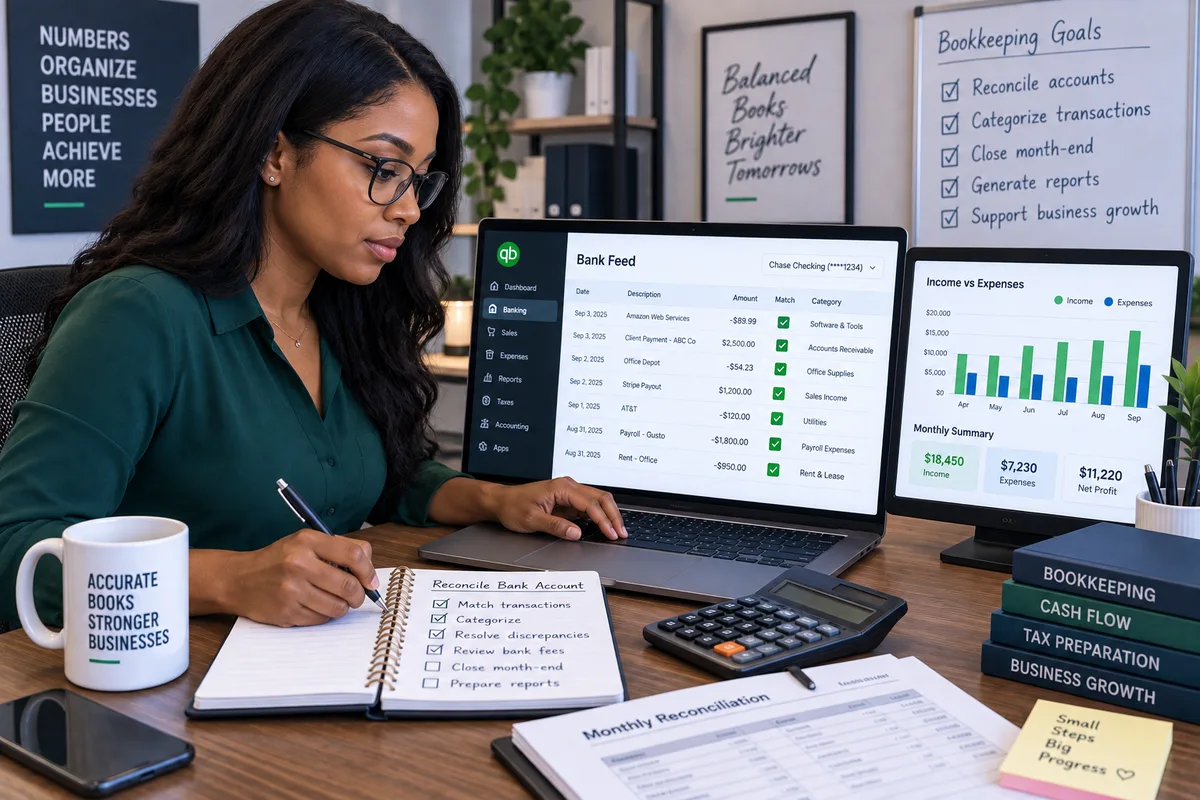
Ten-week certificate course in remote bookkeeping for US small businesses: bank feeds, reconciliation, invoicing, bills, payroll entries, month-end close and owner reports, taught on QuickBooks Online and Xero with a two-week practicum.
Bank feed matching and bank rules
Learn · Practice · ApplyMonthly reconciliation, every account
Learn · Practice · ApplyInvoices, payments and the undeposited-funds account
Learn · Practice · ApplyThe first lesson of the course, open to everyone: what the job really is, how much of it there is in the United States and other western countries, what you will be able to do at the end, and exactly how the ten weeks run.
Explore the full curriculum ↗Welcome to the Virtual Bookkeeping Certificate · about 10 minutes · Narrated course introduction with Academy lesson visuals. Not a student testimonial.
Every small business in the United States has to keep its books. The plumber with two vans, the family clinic, the online shop that sells linen, the marketing agency with six staff. Their owners are good at plumbing, medicine, selling and marketing. Most of them are not good at bookkeeping, and almost none of them want to do it. So they pay someone to do it for them, and more and more of them pay someone who works remotely. This is the Virtual Bookkeeping Certificate from SchoolRegistry Academy, and this first lesson is for two kinds of people. If you are deciding whether to enrol, it will tell you what the job is, how much of it there is, what you will be able to do at the end, and exactly how the ten weeks work, so you can decide with facts. If you have already enrolled, it is your orientation: everything you need to know before Monday of Week 1. Either way, nothing here is graded. I am going to talk to you the way a working bookkeeper would talk to someone joining the trade: plainly, with real numbers, and without promising you anything I cannot stand behind. Let me start with the size of the market, because it is the reason this course exists. The United States government publishes an outlook for every occupation. For bookkeeping, accounting and auditing clerks, it expects about 144,000 openings every year over the decade. Read that carefully: the total number of these jobs is slowly shrinking as software does more, and almost all of those 144,000 openings come from people leaving or retiring. That is the important part for you. The work is not disappearing; the people who did it in an office are, and the businesses still need it done, increasingly by someone remote who knows the cloud tools. The same government source puts the median pay for an in-office clerk in the United States at just over fifty thousand dollars a year. Remote rates from Nigeria are different and I will not quote you one, but that figure tells you what the work is worth to an American business. It is not only America. In the United Kingdom, bookkeeping is a six point eight billion pound industry and still growing. In Australia, the average bookkeeper is forty-eight years old and the industry reports thousands of vacancies it cannot fill as that generation retires. Canada's government job bank rates the outlook for bookkeepers as very good in the regions it reports. And every month, more than twelve thousand people in the United States search for remote bookkeeper jobs, while businesses search for QuickBooks bookkeepers and outsourced bookkeeping in the thousands. This is a trade with a shortage on one side and a cloud on the other, and you can sit in the middle of it from Lagos. Here is what the eight taught weeks cover. Weeks 1 and 2 are the foundations: what a bookkeeper actually does all day, the five types of account that every number in a ledger sits under, how a chart of accounts is built, and then bank feeds and reconciliation. Reconciliation is the monthly proof that the ledger and the bank agree, and it is the first thing any accountant asks about, so we teach it early and we teach it properly. Weeks 3 and 4 are money coming in and money going out: invoices, customer payments, the receivables report, then bills, vendors, receipts, and the contractor paperwork a client's accountant needs from you every January. Weeks 5 and 6 take you into payroll, which you record from a provider's report rather than run yourself, inventory for a shop, the different kinds of client you will meet, fixed assets, and then the month-end close and the three reports every owner reads: the profit and loss, the balance sheet and the cash flow. Weeks 7 and 8 are about people and pressure: writing to an owner who does not speak accounting, working with their accountant at year end, the ethics of the job and the fraud signs a bookkeeper sees before anyone else, managing several clients at once, then a review week that ends in a capstone month where you run a client's books end to end. The whole course uses the same three fictional clients, a plumbing contractor, a family clinic and an online shop, so by the end you know their books like real ones. Now the outcome, and you should hold us to it. When you finish, you will be able to take on a small US business and keep its books current week after week: clear the bank feed by matching before adding, enter invoices and bills from the documents you are sent, and batch your questions to the owner into one message a week. You will reconcile every bank, card and loan account to its statement every month, and when the numbers do not agree you will find the difference rather than hide it. You will prepare the monthly pack, the profit and loss, the balance sheet, the cash flow, the aging reports and the reconciliations, with a cover note in a shape the owner can read in two minutes. You will know where the job stops: you record, reconcile, report and ask, and you never give tax advice, never move money, never decide whether a worker is an employee or a contractor. And you will know how to refuse the requests that get real bookkeepers fired, in words that keep the client. These are not abstract promises. Each one is a lesson with a practice exercise on the simulator, and each one is graded in the practicum, so when you tell an employer you can do it, you will have done it, and you will have the record to show. The mechanics, so nothing surprises you. There are four study days a week, Monday to Thursday, with four short lessons a day, each around ten minutes with a three-question quiz underneath. Pass the quiz and the next lesson unlocks; your best score is the one that counts, and retrying never lowers it. The fourth lesson every day is practice rather than theory: you do the thing you just learned inside Ledgerline Books, the Academy's own cloud ledger. It behaves like QuickBooks Online and Xero without being either, so nothing you learn breaks when a vendor moves a bu
Move from tidy spreadsheets to bank feeds, reconciliations and month-end reports a US business owner can read. Select a moment below to look inside the practice.
Match every line to the document that exists before adding anything new.
Adding first is how duplicates are born.
Put it on the Wednesday batch of questions to the owner, never a drip of texts.
Batching questions is how owners keep answering you.
Send the accountant the year-to-date numbers today and say the question is theirs.
The boundary keeps you employed and the client out of trouble.
Run the checklist in order and lock the period only when it balances.
A close that reconciles is the whole product.
Based on the Academy’s course content and signed-in Playground. Previewing these steps does not create an attempt or save a score.
Try the no-sign-up exercise ↗SchoolRegistry Academy’s Virtual Bookkeeping course is a ten-week online programme for beginners and career changers in Nigeria. First, students learn the five accounts, debits and credits, the chart of accounts and the cloud ledger. Second, students practise bank feeds and matching, monthly reconciliation, invoices and bills, payroll entries from a provider report, and the month-end close in QuickBooks Online and Xero, on fictional US clients whose numbers stay consistent all course. Third, tutor-reviewed assignments, a two-week practicum on a fictional bookkeeping practice and a final assessment create evidence of applied bookkeeping judgment. The October 2026 cohort follows a daily study plan with one live class a week. Certification requires the published completion rules, full tuition coverage and an 80% overall result. The course does not promise employment, clients or income, and it is not certification from Intuit or Xero.
Ask academic questions in the lesson player. The assistant uses lesson context but does not answer assignments or grade your work.
Manage personal work and participate in assigned team tasks with columns, dependencies, comments and history.
Use tutor feedback, explain your changes and resubmit while the original and revised evidence remain available for review.
Your assessed portfolio is private by default. Sharing is optional and revocable. Available learning-media formats depend on the lesson; caption and low-bandwidth processing is still being completed across the library.
Build a habit of learning, applying, and improving. Each part of the week gives the next one a purpose.
Explore your ten weeks ↗Work through self-paced lessons and check your understanding with module quizzes.
Apply what you’ve learned through assignments and track-specific practical exercises.
Join your track’s live session and submit your weekly assignment on the cohort schedule.
From the foundations to your final practical assessment, each stage builds on the last.
Module quizzes check understanding before you move forward. The final assessment includes written and practical work, then two practicum weeks on the job simulator.
The job, the boundary and the client; the five buckets (assets, liabilities, equity, income, expenses); debits and credits without the mystery; the chart of accounts; the cloud ledger, users and the audit log.
How a feed works and what it is not; matching versus adding; bank rules for the boring, never the ambiguous; what reconciliation proves; when it does not balance.
Estimates, invoices and sales receipts; terms and late fees; payments, deposits and the undeposited-funds trap; partial payments and credits.
Bills, expenses and cheques; vendor records and the W-9 you ask for before the first payment; recurring bills; the AP aging and the bill run the owner approves.
What the payroll provider does and what you record; payroll liabilities that must reconcile; inventory and cost of goods sold; the contractor, the clinic, the shop and the agency.
Why the close exists; the checklist; locking the period; the profit and loss read like the owner; the balance sheet and what looks wrong; the October pack.
Writing to an owner who does not speak accounting; questions in batches; reporting a problem without accusing anyone; year-end for the CPA; fraud signs a bookkeeper sees first; scope creep.
The full cycle revisited, the reconciliation-first habit, the boundary revisited, mock questions, a month of feed lines as a practice set, and the assessment itself.
Timed shifts on Ledgerline Books, a fictional bookkeeping practice with real-feeling clients: feed lines arrive, owners answer late, a payroll report lands on Thursday.
More shifts including a downtime drill, a client's question you must not answer, a close under deadline, and a tutor-marked final. Passing needs zero critical errors.
Keep the curriculum, fees, start date, and study checklist in one handy course guide.
Start with good judgment. Try this illustrative exercise and see the reasoning behind a useful response.
Carla texts in December: should I buy a truck before year end for tax reasons?
Choose your next response.
Virtual Bookkeeping Certificate
The SchoolRegistry Academy certificate is assessed through knowledge and practical tasks—not simply time spent watching lessons.
Issued by SchoolRegistry Academy. This is not a third-party accreditation or a guarantee of employment.
A computer, headset, reliable internet, and a quiet place to practice will help you participate. Check the live-session schedule before enrolling.
Future US-client work may involve afternoon or evening hours in Nigeria.
Roles this training prepares you to pursue. Start with the work you want to do, then build the skills to demonstrate it.
Keep the books of one or several small businesses current and reconciled in a cloud ledger.
Bank feeds, reconciliation, close and reports.
Support a bookkeeping practice with feeds, invoices, bills and payment packets.
Invoices, bills, payroll entries and the AP aging.
Record and reconcile for a finance lead who reviews the pack.
The close checklist and owner-readable reports.
Employers may require experience on a specific ledger or a vendor programme such as the QuickBooks ProAdvisor programme. This is a foundation for bookkeeping; it is not accounting, tax or CPA qualification. Employment is not guaranteed; role titles and hiring requirements vary by employer.
The shared Career Readiness course covers your LinkedIn profile, résumé, interview practice, and getting paid as an international remote contractor. Describe practice honestly as training—not employment.
The SchoolRegistry Academy certificate proves you did the work: the ten weeks, a supervised practicum and a final with zero critical errors, verifiable by any employer on our public verification page.
Many employers also ask for QuickBooks Online ProAdvisor certification, issued by Intuit and free to earn. By Week 8 you will have done the QuickBooks Online work the ProAdvisor exam tests, and Week 8 walks every graduate through the sign-up and what to expect.
Together they answer the two questions a hiring manager asks: can you do the work (our certificate, assessed), and does the software vendor recognise your product knowledge (ProAdvisor). One proves the skill; the other proves the tool.
ProAdvisor is issued and governed by Intuit, not by SchoolRegistry Academy; we prepare you and show you the process, Intuit awards the credential. Intuit has kept the QuickBooks Online ProAdvisor training and exam free; we re-check that each quarter and will say so here if it changes.
Need help with your course fee? Apply for a Founder's Scholarship before enrolling. You can also invite a family member, employer, or supporter to sponsor all or part of your training.
Scholarship awards depend on review and available budget. Sponsorship does not guarantee admission, certification, or employment.
Choose your payment option. Get a clear view of the commitment before making your decision.
Pay in full or choose two installments at checkout.
Full course fee · or ₦100,000 × 2 installments
Choose your payment plan securely at checkout.
Questions? Book a free advising call ↗Choose an available time with the Academy team. All times are WAT.
No. The course begins with the five buckets and debits and credits explained without the mystery. What you need is care with numbers, the discipline to ask rather than guess, and a willingness to learn two cloud ledgers properly.
QuickBooks Online and Xero, both on their free trials and sample companies, plus Wave for practising the full cycle at no cost, and Excel or Google Sheets for schedules and reconciliation templates.
No, and the course is strict about it. You record, reconcile, report and ask. Tax questions go to the client's accountant or tax preparer, and Week 1 teaches exactly how to say that to a client.
No. The owner connects the bank feed to the ledger. You never hold a bank login, and the course teaches you to refuse one if it is offered.
Yes. A SchoolRegistry Academy certificate with a unique ID and a public verification page is issued when the published completion rules are met, including the final assessment and the practicum with zero critical errors.
October 12, 2026 at 11:00 AM WAT (Nigeria). Each track has one live class a week; the day is confirmed in your enrollment information.
No. The Academy develops and assesses skills. Employment depends on your performance, employer requirements, and available roles.
₦200,000 covers this track. You can pay in full or in two ₦100,000 installments, with the balance due three weeks later. Review the handbook and checkout terms before paying.
Talk through this course, your experience and how to get started. Choose a time from the Academy team’s shared availability.
See available advising times ↗Employers and partners can confirm the current status of a shared SchoolRegistry Academy certificate using its 12-character ID.
Verify a certificate ↗Use these existing SchoolRegistry guides to compare the wider career decision before you enroll.
Virtual Bookkeeping Certificate · SchoolRegistry Academy