
Small US carriers and owner-operators hire remote dispatchers to keep their trucks loaded, legal and paid. Here is what the work is, the one line that keeps you out of trouble, who hires, and how to train for it.
Truck Dispatcher Jobs From Nigeria: What US Carriers Hire Remote Dispatchers to Do
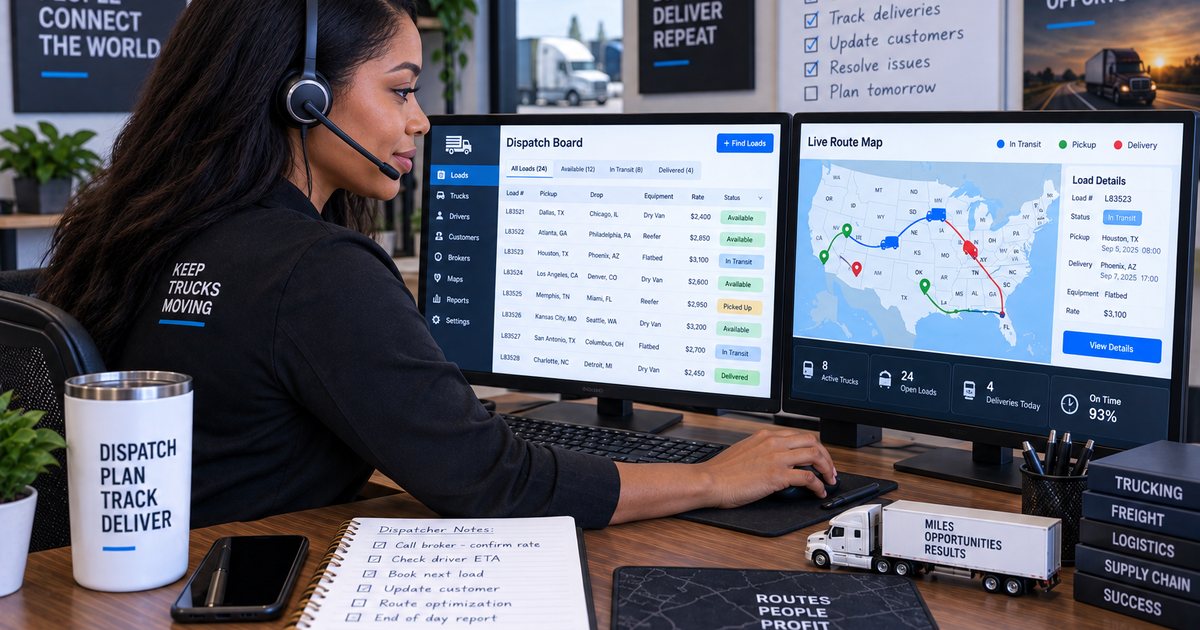
A remote truck dispatcher works for a carrier under a written agreement: finds loads on the boards, calls brokers, negotiates inside the carrier's floor, checks every rate confirmation, plans around the driver's legal hours, assembles the paperwork that gets the carrier paid, and reports the week to the owner. A dispatcher is the carrier's agent, paid by the carrier, and never a broker; crossing that line is a federal matter. Nigerians hold these roles through dispatch services and direct carrier contracts, working US hours.
SchoolRegistry Editorial Team · Last updated: September 2026
The description matches what US carriers ask of remote dispatchers and the Academy's Truck and Freight Dispatcher track. Regulations are named so you can find them; nothing here is legal advice.
What a dispatcher actually does
Monday morning, eight trucks. One is empty in Dallas with a driver who has 38 hours left in his week and wants to be home Friday. A broker calls with a Chicago load that pays, if the pickup window fits the driver's clock. The dispatcher reads the board, works out the all-in cost per mile that decides every yes, calls on the load, confirms every number back, checks the rate confirmation field by field before the driver rolls, and logs the call so the record settles any dispute later.
The rest of the week is paperwork that gets the carrier paid (rate confirmation, bill of lading, proof of delivery, lumper receipts), chasing slow brokers, deciding whether to factor an invoice, handling the breakdown call in the right order, and telling the owner the truth about the truck that lost money.
The line: carrier's agent, never a broker
A broker, under US federal rules, arranges freight for a shipper for compensation and must hold authority and a bond. A dispatcher works for the carrier, is paid by the carrier, never solicits shippers and never touches freight funds. Working under a written dispatch agreement, paid by the carrier, is what keeps you on the right side of that definition. The courses that promise you can start your own dispatch business and take a cut of loads from anyone are, at best, careless with this line.
The other line: the driver's legal hours
US drivers work under hours-of-service limits recorded on an electronic logging device. A dispatcher plans loads around the driver's remaining clock and never books a load a driver cannot legally run. There is no lesson, and no job, in which a late load is worth a violation.
Who hires Nigerians for this
Dispatch services that serve several small carriers and staff their desks remotely. Owner-operators who contract a dispatcher directly. Small fleets that run a desk on US hours with a remote team. The dispatch services are the usual first step; direct carrier contracts come with a track record. Every employer asks the same things: can you hold a phone call with a fast broker and a slow driver in the same hour, can you do the arithmetic, and will you tell the owner bad news as it is.
How the Academy trains it
The Truck and Freight Dispatcher track is ten weeks on the Redline Carriers desk, a fictional eight-truck fleet with named drivers, brokers and lanes whose numbers stay consistent all course. Load boards on a sandbox, cost per mile from the dataset, recorded calls scored for clarity, hours-of-service planning, payment packets, factoring, breakdowns, and the weekly owner report. It costs ₦250,000 and ends in a certificate an employer can verify. It does not make you a broker or a carrier and does not promise a job.
Sources & Further Reading
- FMCSA, Registration and operating authority — the federal source for what brokers and carriers must hold, and the free lookups a dispatcher uses to vet a broker
- FMCSA, Hours of service summary — the official summary of the driver limits a dispatcher plans around
- SchoolRegistry Academy, Truck and Freight Dispatcher track — the curriculum, tools and sample lesson
Frequently Asked Questions
Can I really dispatch US trucks from Nigeria?
Yes, remote dispatching for US carriers is a real job, worked on US hours with a reliable connection and a backup plan, under a written agreement with the carrier. The course is honest about what that takes.
Is this the same as being a freight broker?
No. A broker holds authority and a bond and works between shipper and carrier. A dispatcher works for the carrier. The course is strict about the difference because getting it wrong is a federal matter.
Do I need a load board subscription to learn?
No. The course practises on a sandbox board and shows you DAT One and Truckstop so the real ones are familiar.
What does it pay?
Dispatchers are paid by the carrier, usually a percentage of linehaul or a flat fee per load, and it varies. We do not print figures; the course teaches you how the arrangement works so you can judge an offer.