
US clinics hire remote administrative staff for scheduling, eligibility checks, prior authorizations and records requests. Here is what the work is, the rules that sit under it, and how Nigerians train for it.
Medical Virtual Assistant Jobs for Nigerians: What US Clinics Actually Hire You to Do
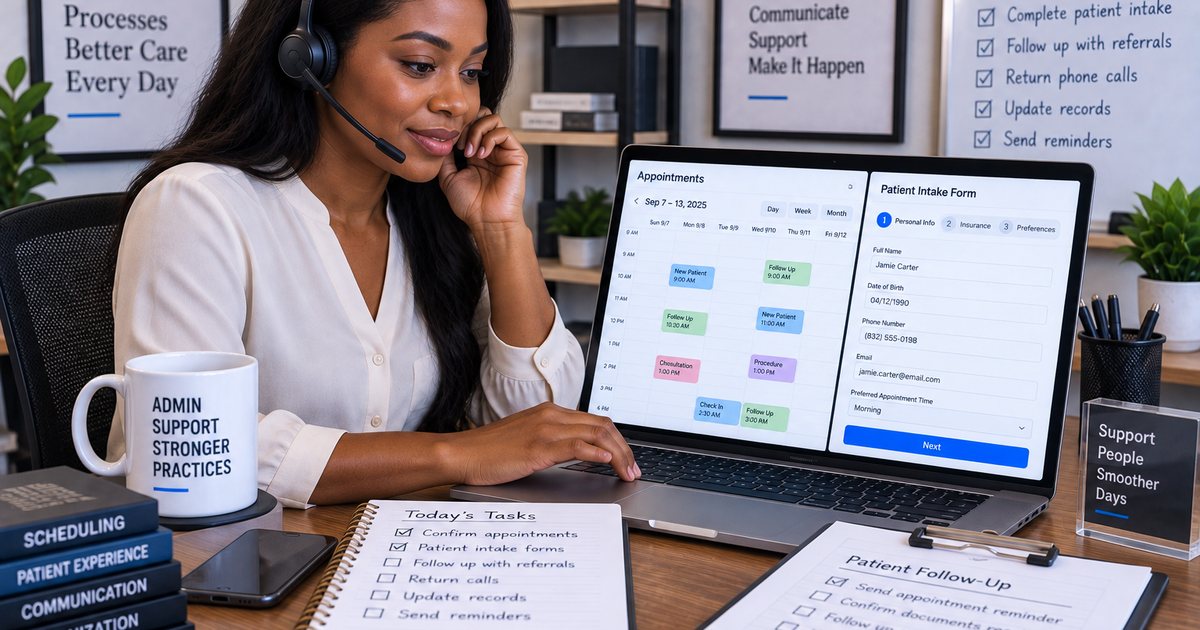
A medical virtual assistant is a remote front-desk and back-office worker for a clinic: patient messages, appointment scheduling, insurance eligibility checks, prior authorization packets, referrals and records requests. It is administrative, never clinical, and it lives inside US privacy rules, so the first thing any clinic tests is whether you follow the verification and disclosure rules without being reminded. Nigerians reach these roles through staffing agencies and direct clinic hires; the Academy's VMA track trains the job on a fictional clinic system before you touch a real one.
SchoolRegistry Editorial Team · Last updated: September 2026
The job description here matches the tasks in current US postings for remote medical administrative assistants and the Academy's Virtual Medical Administrative Support track. Nothing here is clinical or legal advice; the privacy rules are named so you know they exist, not interpreted.
What the job actually is
A clinic's front desk has more inbound than hands: phone calls, portal messages, insurance questions, referral paperwork, records requests from other providers. A medical virtual assistant takes the part that can be done from a distance. You confirm who is calling before you say anything about a patient. You schedule and reschedule inside the clinic's rules. You check a patient's insurance eligibility on the payer's portal. You assemble a prior authorization packet and chase its status. You route a records request to the right place with the right consent attached.
What you never do: give medical advice, interpret a result, or share anything with anyone who has not been verified. The daughter who calls for her mother's results is the classic test, and the correct answer is a verification and a routing, not a kindness.
The rules under the job
US health privacy law (HIPAA) sets the frame for every one of these tasks. You do not need to interpret it; you need to work inside a clinic's procedures that implement it: two identifiers before any disclosure, the minimum necessary, approved channels only, and a record of what was shared with whom. Clinics hire remote staff only when they are confident those habits are automatic. That is why the training has to happen on a system that behaves like the real one, with the traps built in.
Who hires, and how Nigerians get in
Three routes. US staffing agencies that specialise in remote healthcare admin and place assistants with clinics. Direct hires by small practices that already use remote staff. And larger practice groups that contract remote administrative teams. Agency routes are the most common first step for Nigerians because the agency handles the client relationship and the compliance paperwork.
Every route asks the same questions: can you handle a phone call under pressure, do you follow the rules without being told twice, and can you document what you did. Practice on a real-feeling clinic system is the answer to all three.
How the Academy trains it
The Virtual Medical Administrative Support track is ten weeks on NorthChart, a fictional clinic system with role-based access and an audit trail. You practise patient messages, scheduling, eligibility, prior authorization packets, referrals, records requests and claim status calls, with planted traps: the unverified caller, the request that would leave the approved channel, the downtime drill. Six practicum shifts and a final pass only with zero critical privacy errors. It costs ₦250,000, does not teach clinical work or medical coding, and is not a HIPAA certification; it is practice at the job, assessed, with a verifiable certificate at the end.
Sources & Further Reading
- US Department of Health and Human Services, HIPAA for professionals — the official source for the privacy rules named above
- SchoolRegistry Academy, Virtual Medical Administrative Support — the track this article describes, with its sample lesson and fee
Frequently Asked Questions
Do I need a medical background?
No. The job is administrative. A calm phone manner, careful reading and the discipline to follow verification rules matter more than any clinical knowledge.
Is this the same as medical coding or billing?
No. Coding and billing are separate specialities with their own certifications. This role supports the front desk and the back office around them.
Can I really work for a US clinic from Nigeria?
Remote medical administrative roles are real and Nigerians hold them, usually through agencies. What the clinic controls is what you can access; you work inside their systems under their rules.
What does it pay?
It varies by agency, clinic, hours and market. We do not print a figure; check current postings and ask the agency directly.