
NJFP 2.0 pays ₦150,000/month for a real 12-month placement, but only 23,724 spots exist nationwide. Here's the real math, how to apply, and what a serious backup plan looks like if this cycle doesn't go your way.
NJFP 2.0: What It Actually Is, and What To Do If You're Not Selected (2026 Guide)
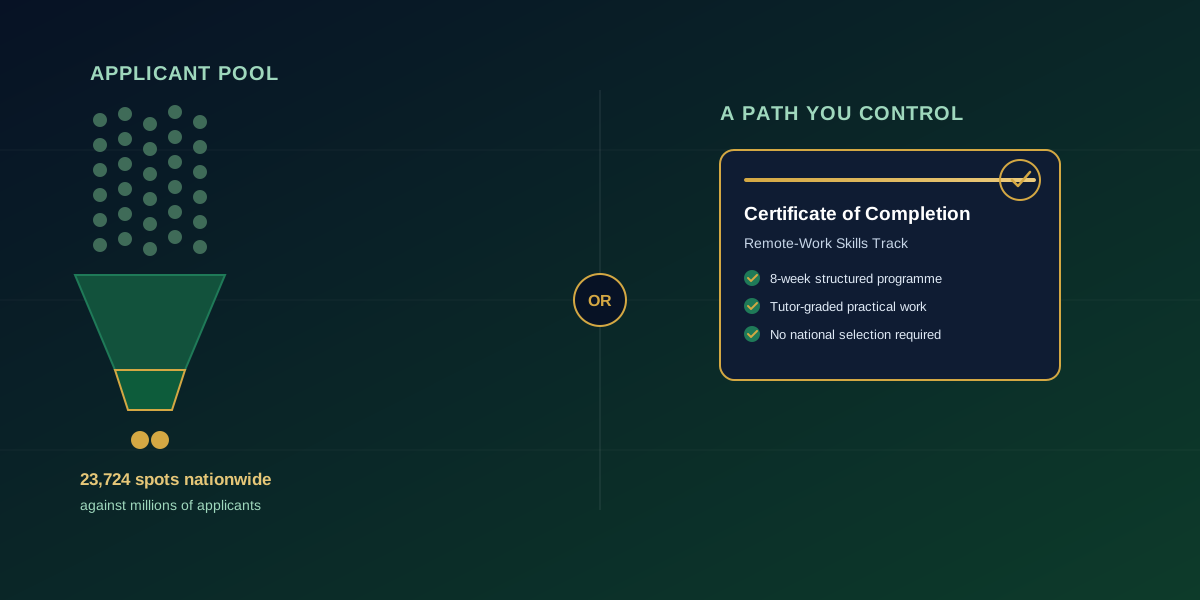
NJFP 2.0 is a real, government-backed programme paying ₦150,000 a month for a 12-month placement, run with UNDP and EU support. It is also targeting only 23,724 fellows nationwide, against a youth population where broader unemployment and underemployment sits near 53%. Apply if the window is open, it is free and legitimate. But do not wait on it alone: an 8-week certification in a real remote-work skill (customer service, virtual assistant, IT support, lead generation, social media management) does not depend on being one of the 23,724, and the credential does not expire after 12 months.
SchoolRegistry Editorial Team · Last updated: September 2026
This page reflects NJFP 2.0's programme structure and Nigeria's official labour statistics as of the date above, sourced from njfp.ng, UNDP Nigeria and the National Bureau of Statistics. Application cycles, stipend amounts and eligibility rules can change. Confirm current requirements directly on the official NJFP portal before making a decision based on this article.
It is 11:47pm and you are refreshing the NJFP portal for the fourth time tonight. Nothing has changed since the last refresh, or the one before that. Your data is almost finished. Tomorrow you will borrow your cousin's phone to try again, because his network sometimes loads the page faster than yours. You already know the numbers do not favour you. You are applying anyway, because what is the alternative: stop applying and stop hoping?
This is not a dramatization. It is a fair description of what checking NJFP status looks like for a large share of Nigeria's graduates right now, and it is exactly the position the Nigeria Jubilee Fellows Programme's second phase, NJFP 2.0, has put hundreds of thousands of young people in. The programme is real. The stipend is real. The 23,724 spots are real. What is also real, and rarely said plainly, is that most people who apply will not get one of those spots, through no fault of their own effort or qualification. This piece is about what NJFP 2.0 actually is, what your real odds are, and what a serious next step looks like if this round does not go your way.
What NJFP 2.0 Actually Is
The Nigeria Jubilee Fellows Programme is a Federal Government initiative, run in partnership with the United Nations Development Programme and supported by the European Union. NJFP 2.0 is the current, relaunched phase of the programme, and it places selected fellows into structured, paid 12-month work placements with host organisations across the public and private sectors. Fellows receive a monthly stipend of ₦150,000 for the full 12 months, along with mentorship and, in many placements, genuine hands-on professional experience.
NJFP 2.0 covers all 36 states and the FCT, and placements span sectors including technology, education, agriculture, health and finance. The stated national target for this phase is 23,724 fellows. That is a real, large number. It is also, set against Nigeria's actual youth population, a small fraction of the people who will apply for it.
NJFP 2.0, in numbers
Monthly stipend, paid for the full placement.
Length of a single placement, not a permanent job.
National target for this phase, across 36 states and the FCT.
Key Terms, In Plain Language
- NJFP 2.0 —
- the second, relaunched phase of the Nigeria Jubilee Fellows Programme, currently targeting 23,724 placements.
- Fellow —
- the official term for a selected applicant once they are placed with a host organisation.
- Placement —
- the 12-month working arrangement between a fellow and the host organisation they are assigned to.
- Host organisation —
- the public or private sector employer a fellow is placed with for the duration of the programme.
- UNDP —
- the United Nations Development Programme, the UN agency partnering with the Federal Government to deliver NJFP.
None of this makes NJFP a scam, and it is worth saying that directly. Frustration with how slowly an application can move, or with silence after submitting one, is a real and common feeling, and it shows up constantly in Nigerian online communities where people compare notes on government programmes. But a programme that is slow, oversubscribed or unevenly communicated is not the same thing as a programme that is fake. NJFP 2.0 is a legitimate opportunity. It is simply not built to reach everyone who needs it, and you should plan accordingly.
The Real Math Behind 23,724 Spots
Here is where the numbers get uncomfortable. Nigeria's official youth unemployment rate, as measured by the National Bureau of Statistics, stood at 6.5 percent in the second quarter of 2024, down from 8.4 percent the quarter before. That sounds almost manageable, until you understand how that number is built: under the current methodology, anyone who worked at least one hour in the reference week counts as employed. A graduate who sold recharge cards for an hour last week is "employed" by that measure, regardless of whether they have anything resembling a career.
A broader measure tells a different story. The State of the Nigerian Youth Report 2025 put youth unemployment and underemployment combined at 53 percent. That figure is not directly comparable to the NBS number, because it is measuring something different: not just whether you worked an hour, but whether the work you have actually matches your effort, your training and what you need to live on. Both numbers are real. They are simply answering different questions, and the second one is closer to what most young Nigerians actually experience.
Against either version of that picture, 23,724 placements is a real, meaningful number of opportunities, and a very small one. It is not a criticism of the programme to say this plainly. It is the actual arithmetic every applicant is up against, and pretending otherwise does nobody any favours.
How to Apply, Step by Step
If you have not applied yet, the real process is straightforward, and worth doing properly rather than rushing:
- Go to the official NJFP portal directly (njfp.ng) rather than a link shared in a WhatsApp group or forwarded message. Government programme phishing is common enough that this step matters.
- Confirm the current application window is actually open before you start. NJFP runs in defined cycles, not on a rolling basis.
- Prepare your documents in advance: a working email you check regularly, your NYSC discharge or exemption certificate where applicable, and your CV.
- Fill in the application completely and accurately. Placements are matched to sectors and stated skills, so vague or padded answers do not help you.
- Save your application reference and check status through the official portal only. NJFP does not ask for payment at any stage of the process.
What Happens If You Are Not Selected
This is the part almost nobody writes honestly about, so here it is: if you are not selected this cycle, nothing about your ability or your effort has been judged. You were one of an enormous number of qualified applicants competing for a fixed, much smaller number of spots. The disappointment is real and it is allowed to hurt. What matters next is what you do with the months while you wait for the next cycle, or while you build a path that does not depend on being selected for anything at all.
A 12-month NJFP placement, when you get one, is valuable precisely because it gives you structured experience and a stipend while you build toward something more permanent. That is also exactly what a real, verifiable skills certification does, except it does not require you to win a national lottery to start, and it does not end after 12 months with you back at the same starting line.
NJFP 2.0 vs. a Remote-Job Certification: What Is Actually Different
These two paths are not really competing with each other. They solve different problems, and understanding the difference matters more than picking a side.
| NJFP 2.0 | SchoolRegistry Academy | |
|---|---|---|
| What it is | A 12-month paid placement with a host organisation | An 8-week certification in a specific remote-work skill |
| How you get in | National selection against a large applicant pool | Enrollment, open to anyone who completes the programme |
| Cost | Free to apply | ₦200,000, with an installment option |
| What you earn | ₦150,000 per month during the placement | No stipend during training; real remote roles typically start well above local entry-level pay once certified |
| What happens after | Placement ends after 12 months | Certification and portfolio evidence are permanent and portable to any employer |
The honest version of this comparison is not "choose one." It is: apply to NJFP 2.0 if the window is open, because it is a real, free opportunity. And build a skill in parallel that does not depend on being one of the 23,724, because the odds say most applicants need a second plan regardless of how strong their application is.
What SchoolRegistry Academy Actually Teaches
SchoolRegistry Academy runs five 8-week certification tracks, each aimed at a specific, real category of remote job that US-based companies actively hire Nigerians for: customer service and call centre work, virtual assistant support, social media management, lead generation and appointment setting, and Tier-1 IT support. Every track includes real practical assessments graded by a tutor, not just video lessons, so what you finish with is evidence you can show an employer, not only a certificate that says you watched something.
Enrollment includes the Getting Hired: Career Readiness course at no extra cost, covering interview preparation and the practical, unglamorous parts of actually landing and starting a remote role. The next cohort begins October 1, 2026.
Myths vs. Facts
Myth
NJFP is a scam, or the government never actually pays out.
Fact
NJFP 2.0 is a real Federal Government programme delivered with UNDP and EU support. The frustration people vent online is almost always about slow processing or silence during selection, not fabricated payments.
Myth
You have to pay an agent or "verify" your slot to get selected.
Fact
Applying is free at every stage. Anyone asking for payment to apply, secure or speed up a slot is not part of the official programme, full stop.
Myth
Not getting selected means you were not qualified.
Fact
23,724 spots against a national youth population where over half face unemployment or underemployment means most qualified applicants will not be selected in any given cycle. That is arithmetic, not a judgement on you.
Sources & Further Reading
- NJFP official portal (njfp.ng) — the only place to apply, check status, or confirm the current cycle is open.
- UNDP Nigeria — NJFP's implementing development partner, with programme background and reporting.
- National Bureau of Statistics, Nigeria Labour Force Survey, Q2 2024 — the primary source for the 6.5% youth (ages 15-24) unemployment rate, down from 8.4% in Q1 2024, and the 4.3% overall national unemployment rate for the same quarter.
- Plan International Nigeria & ActionAid Nigeria, "State of the Nigerian Youth Report 2025" — the primary source for the 53% youth unemployment-and-underemployment estimate, covering an estimated 80 million young Nigerians.
We link directly to primary sources rather than restating secondary summaries. If NJFP's terms or Nigeria's labour statistics are updated after this article's last-updated date above, the official sources take precedence over anything written here.
Frequently Asked Questions
Is NJFP 2.0 a scam?
No. NJFP 2.0 is a real Federal Government programme, delivered in partnership with UNDP and supported by the EU. Slow processing or a lack of updates during a selection cycle is a common frustration, but it is not evidence the programme itself is fraudulent.
Does NJFP 2.0 cost anything to apply?
No. Applying is free. Anyone asking you to pay to apply, to "secure" a slot, or to speed up processing is not part of the official programme.
What are my real chances of being selected?
Nobody publishes exact odds, but with a national target of 23,724 fellows against a youth population where the broader unemployment and underemployment measure sits around 53 percent, the honest expectation is that most applicants in any single cycle will not be selected.
Can I apply to NJFP and do a certification programme at the same time?
Yes. They are not mutually exclusive, and the two-month structure of an Academy track fits around most application and waiting periods.
What happens after an NJFP placement ends?
The 12-month placement itself concludes; what continues is whatever experience, references and skills you built during it. This is the same reason a permanent, verifiable certification is worth having alongside or after a placement, rather than in place of one.
SchoolRegistry Academy, Quick Facts
Price
₦200,000
Format
Online, tutor-graded
Duration
8 weeks
Next cohort
Oct 1, 2026
Five remote-work tracks, real practical assessments, and the Getting Hired course included at no extra cost. No selection lottery, no waiting for a national cycle.
See the Academy tracks →